Thriving Mindfully

Tag: perspective (Page 11 of 17)

Lesson from Failure (Power of Everyday Project – July Update)

I have always been interested about the possibilities consistent practice has to offer. That is what led me to start ‘The Power of Everyday’ project where I take a few activities that matter to me and promise to do them every single day.

While I have had experiences of inconsistent practice for most of my adult life, and recently had success for a couple of months at being extremely consistent ever since I started the project,
I gradually fell back into the trap of  inconsistency in the month of July.

That explains much of my inconsistent blog publishing schedule and inactivity in daily life.
While I could reason it with the gloomy monsoon weather and a 10 day trek where I had no access to Internet or electricity, deep down I know,
excuses apart,
Plain and simple,
I did not deliver on my promises.

Here’s my performance sheet for reference :

Action based goals

1) Practise Yoga Everyday (7/31)
2) Write and Publish a blog everyday (9/31)
3) Write Haiku Everyday (11/31)

Awareness based goals

1) Posture awareness (7/31)
2) Zero waste lifestyle (24/31)
3) Celibacy (31/31)

As it is evident, apart from the last task, I did quite dismally in all the rest.

But even in failure, I had great success in learning about myself.

a) For example, while being mindful of my posture, I realised how my walking posture and foot landing habit is affecting the overall balance of my body. I had been struggling with frail balance of my body for a few years. Only when I started to  observe my body did I realise what was wrong and now I can look for ways to improve.

b) While I could not avoid packaged products entirely, I along with my friend Lee, manager to collect 5 kgs of trash all along our trek in Nepal. In the process we could understand why people need to carry package food on challenging treks just like we did.
Also, we realised that there could be ways to better the situation.
For example, with each treking permit there should be a garage bag handed out so that a trekker has an option to collect the trash he produces.

c) I also realised that writing keeps me alive, present and excited about living each day. The moment I stopped to write and share it with the world, I felt a sense of gloom dawn upon me. It was a great feeling to realise how much a particular habit mattered to my emotional well being.

4) And above all, as I wrote this post, I realise how therapeutic the process of confronting your own failure is.
I feel more accountable to you in a way.
It would be so easy to hide my shortcomings.
But that does not serve growth, neither mine nor yours.

I had a great month nevertheless, full of novel experiences like experiencing Nepal as a culture, going on my first 10 day extended trek , meeting free roaming Yaks at 4000 meters above sea level, watching a glacier turn into a might river that flowed across borders and most importantly, I got to spend time with a dear friend in nature for two weeks.

I am grateful for being able to experience these wonders of life.

For the next month,
I have only two awareness based goals for the Power of Everyday project, August Edition.

1) Stay without the internet for a month
2) Stay Celibate

As the first goal suggests, I will not be posting any new blogs in the month of August.
Still, I will be writing, reflecting and compositing more meaningful work and will share it with you when I am back online in the month of September.

I hope those of you who took a challenge for the Power of Everyday project learned something in the process. Feel free to share your reflections in the comments below.
As I mentioned earlier, there’s grace in accepting even our failures because only then do we keep your mind open for reflection and improvement.
Even if you did not keep up to your promises, reflect on why that happened and how you could perform better in future.

Also, if the project excites you, please take up a challenge for the month of August and share your learnings at the end of the month.
You can share your challenge in the comments below for the sake of accountability 🙂

Hoping to see you on September 1st with fresher perspectives.

With love,

Sreenath
What I learnt about brotherhood after having a Nepali Thali

It was my maiden visit to Kathmandu, Nepal.
My country India and Nepal share a common history, ancestry, culture and religion with each other,
ties that can be traced back to many millennia.

So, I wasn’t much surprised when I found as much a sense of familiarity as a deep sense of novelty with Nepal at first glance. The people dressed the same as Indians did, the vehicles on the road were the same as back home and so was the nonchalant acceptance of chaos on the streets.
Even the shops had much of their stock imported from India.
Much to my surprise, I could even use Indian currency to shop in Nepal.
In many senses, Nepal felt like a younger brother to India.

To me, the most lasting cultural experience in a new country is the culinary delights it has to offer. Walking unsuspectingly along a backpackers’ ghetto, I looked around for signs of authentic Nepali cuisine.
I spotted a restaurant where locals were having their afternoon meal. Its warm and inviting energy beckoned me in.

The first dish on the menu was Nepali Khana Set Thali. Without another thought, I placed an order for one.

Within minutes, I had Thali (Plate) on my table.
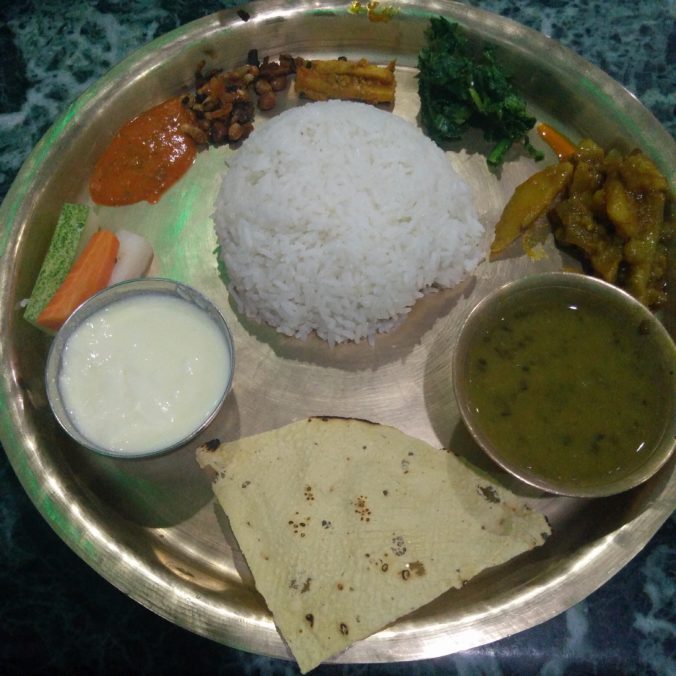
The Thali was made of a copper alloy, with a couple of small bowls arranged on the side.
The contents looked quite similar to a Thali back in India.
A dollop of steaming hot rice, a bowlful of Dal (Lentil soup), a curry of potatoes and peas, a green spinach stir fry, a dried leafy fermented vegetable preparation, three different pickles and a token salad of one slice each of carrot, radish and cucumber.

By the looks of it, I was expecting a much similar taste as that of a regular Indian meal.
But boy was I wrong !
Each subsequent bite only took me by delightful surprise.

The rice was pearly and mildly sticky, cooked to perfection, tasty even just by itself. The dal was a perfect masquerade, looking every bit like the India dal but having a teasingly peculiar flavor, spiced delicately but by no means spicy.
The potatoes and peas, blended easily with whatever else you chose to eat it with.
The greens were cooked just right, minimally, with the right amount of water retained to keep it succulent. It was the perfect example of how to cook greens, right to the sweet spot.

I was particularly surprised by the fermented mustard leaf preparation called ‘Gundruk’, a flavor reminiscent of Punjabi Sarson da saag but tasting nothing like it.
Then, came the deal breaker trio of pickles. A spiced radish slice fermented just right and nuggets of soybean peppered with chilli and coriander.
As surprisingly flavorful as they were, the icing on the cake was the red achaar on the Thali.
At first I could not even tell what it was made of. Each time I tasted it, it whispered one of the ingredients to my tantalised toungue.
With a base of Nepali tomatoes, it had undertones of local chilli (khursani) , coriander , salt and the soul of Nepal in some way. It had a tangy yet citrus aftertaste, a heavenly blend of ingredients.

Each morsel of the meal had such personality, it felt as if I was having an intimate meeting Nepal with each bite.
Ofcourse, I asked for second portions of each dish and ate as avidly as the first time.

Satiated with this surprise of an experience, with a loosened belt, I sat back wondering..

It is likely that many of the ingredients in this Thaali were imported from India. Yet, each and every dish, can stand on its own,
working together to create an experience even better than the sum of its parts.

In a way, my preconceived notion about Nepal was proven to be wrong within the first few hours.

It was quite akin to the experience of brotherhood.
An elder brother undoubtedly has a deep influence on his younger sibling. And sometimes it is taken for granted by the elder one how his younger brother would imitate much of what he does.
Being a younger brother in real life, I have been through this imitation game.
Hence, I could understand why I expected a Nepal Thali (Say younger brother) would be quite similar to the character of the Indian Thali (Elder sibling).

But it is a moment of great pride to realise how a younger brother has its own individual voice, despite the common background and upbringing.

Through this culinary experience, despite being the younger sibling in my family,
I could feel the elation of an elder sibling when he realises that his younger brother has always had such a distinct and pleasing character.
Much of it has also to do with my lack of exposure and awareness about the Nepali cuisine and culture.

But now,
My respect and admiration for Nepali culture has found firm ground in my heart.

I see the Thali in front of me at the moment. I finished everything on the plate but the salad.
Neatly arranged still,
There are three slices of Carrot, Radish and Cucumber,
Shades of orange, white and green,
Reminding me of the Indian flag, feebly hinting at our common culture despite our distinct geopolitical reality.

I smile.
And deep in my heart,
I know I will have many more Nepali Thalis to relish this unique experience,
Of the perfect blend of
familiarity and novelty.

The most important quality of a leader

There was a pleasant stillness in the air.

My friend Lee and I were sitting on the banks of a placid glacial lake called ‘ Tsho Rolpa’ . We had been treking uphill for the past 5 days and we’d finally reached our destination at 4550 meters above sea level, barely 5kms from the Nepal-China border.

It was the first time we had seen a glacier feed a glacial lake that in turn became the source of the mighty Rolwaling-Kosi river we were trekking on the banks of for the past few days.

As the weather turned moody we decided to walk back to the village where we were staying.
As soon as we reached back at our host’s place, Lee fell asleep right away.
I assumed that he was worn out by the long walk and needed rest.

He woke up only briefly in the evening to have dinner and disappeared in the blankets for the rest of the night.

Hoping that he would feel fine by morning, I too rested myself for the night.

The next morning, I awoke to find Lee sitting peacefully on his bed.

‘Lee, How do you feel now?’ I asked.

‘I feel so happy about what happened yesterday’ he shared with a lilting half smile on his face.

‘You mean, our journey to the lake?’

‘Yes that too. But I am happier for something else.
Do you know, I had such a severe splitting headache ever since we got back from the lake?’

‘Ah, altitude sickness is it?’ I asked.

‘Yes.
It is the first time in my life I experienced altitude sickness.
I have trekked so much all my life in Korea, led teams of upto 80 people on treks, but I have never faced this situation before.
Many people in my teams would experience health issues at high altitude but I could never help them in the best manner possible for lack of experience.
Now, that I have experienced it,
I can understand the situation of another human being who is going through altitude sickness.
Now I am in a better position to help someone in need.’

I could only nod and marvel at the beautiful way he turned a hardship into a learning experience.

‘Indeed Lee, You are in a great position to help. Now I can scale more mountains with you.
If I ever feel altitude sick,
You’ll empathise and help me out won’t you !’

His peaceful face was half lit from the sunlight infiltrating through the seive of the curtain.
He nodded.
His demeanor was placid as the lake we saw yesterday,
Holding the promise to flow like a mighty river,
Seeking to help someone in need at every moment possible.

This little interaction was a deep sermon.
I would often relate leadership with power, rank and authority.
But this warm hearted person, through his own experience,
Taught me how,
The foremost quality in a good leader,
Is Empathy.

What I learnt by taking up the ‘Power of Everyday’ Project

“We are what we repeatedly do.”
“Each day is a day of decision.”
“He is rich who owns the day.”
“Each new day is a blank page in the diary of your life.”

Most of us have read similar lines at some point in our lives, gotten motivated for a while only to gradually slip back into inaction.

When Sreenath started his ‘Power of Everyday‘ project, I had been through this cycle a hundred times over- to the point where instead of leaving me inspired, every variation of these aphorisms was reduced to a feel-good bromide.

However, long before Sreenath formally announced the project, I had seen him reap benefits of maintaining self-discipline. So it was inevitable that when he invited his readers to join him, I would be among the first guys to respond.

I am guilty of being slightly disorganized and sloppy about certain areas of life. A full-time job has made me gradually fall in the trap of living day-to-day, rather than maximizing each day to make progress toward interests that are closer to my heart.

I don’t think I am alone in feeling dazed and unplanned on certain days. Life is busy. Breaking out of the uni-dimensional routine of our days is a perennial struggle. My willingness to play a part in Sreenath’s project is a result of my optimism that we’d all benefit from staying mutually accountable to each other about the way we live our days.

For my first month of this challenge, I decided to choose three fairly simple and realistic everyday tasks-

1. Wake up before sunrise

Success rate- 19/30

In my college years, I had identified waking up early as one of the keystone habits– a habit that is precursor to the
development of other good habits. However, I have had a long history of failed experiments of waking up early for more than two weeks consecutively.

In order to sustain this habit, it was important for me not to have this seem like a mental and physical ordeal. So, I decided to make this a fun exercise by taking up an implicit, one-sided, and undeniably juvenile competition with the Sun.

2. Do the 7-minute-workout

Success rate- 21/30

At the start of the year, I resolved to run five half-marathons by the end of the year. My second half-marathon of the year was scheduled on June 24 and I was terribly unprepared. Working for long hours on some days of the month made it harder for me to run as frequently as I should have. The 7-minute workout was a significantly less time-intensive exercise routine to maintain my stamina. While nothing could replace a good morning run, this was a decent substitute and it helped ensure that I completed what could arguably be one of the toughest terrains on the Indian marathon circuit with marginal unease.

3. Compose a simple melody everyday (14/30)

Success rate- 14/30

Practicing technique and scales has always been one of my major aversions. To resume practicing more efficiently, I needed to go back to the reason why I picked up my first guitar- to play tunes. Those dreaded arpeggio patterns and the ghastly chord voicings took a back seat, and I started focussing on humming simple melodies over various chord progressions everyday. I failed more often than I succeeded in this endeavour, but this was the most rewarding activity of my day.

Where I failed, and what I learnt?

It’s pretty evident from the numbers that I was wildly inconsistent.

I learnt that developing a habit is mainly about momentum.

Momentum is created or destroyed every day with the first few decisions I make. For example, I went on a 10-day streak on all three tasks, but once I missed waking up early a few days in succession, I couldn’t create a respectable streak.

The biggest problem I encountered was when I woke up late or started my day off wrong, which put me on a downward spiral for the rest of the day.

Most of all recognized that my willpower works pretty much like a muscle. On days where I was exhausted after utilizing my will-power in responding to a plethora of e-mails and answering to unnecessary phone calls, it was harder for me to come back home and sit with my instrument to come up with a melody. On those agonizing work days, I found myself noodling mindlessly on my guitar instead of engaging myself in a focussed practice session.

With all the down sides, I had the opportunity to learn a lot about myself in the process.

This month, I am expecting some stressful days at my workplace and also planning to initiate a side project which would take up most of my time. Thus, keeping with the idea of setting realistic goals, I am deliberately not over-exerting myself and taking up any new goals for this month.

While I wasn’t as successful as I had hoped to be, I am taking solace from the fact that at least I have put in place a system of tracking my progress and keeping myself accountable here.

This is a wonderful project and doing this experiment has reinforced the idea that all I need to do stay happy is become very, very good at living each day. I would like to extend Sreenath’s invitation to his readers in choosing a simple task that you’d like to do every single day and experience the progress first hand, just like I did.

I hope to see you guys again at the end of July.

Cheers,
Aalap Vyas


Finding honest critique in the age of constant gratification

In today’s age of hyper-connectedness it is easier than ever before to share your your life, your work of art with the world.
We have cleverly designed platforms that we choose to express ourself through.
While these social media platforms have simplified the act of expression,
It has also sowed inside us, a seed of constant hunger,
Of seeking validation.

Today, the act of creating itself cannot find the isolation it needs.
We are busy sharing that we are going to do something, we have just started doing something…..Up until we are finished with doing something.
We fail to shut the door on the world to actually get to the process of creating something without distractions.
It is the result of the clever architecture of these platforms that are dictating our behavior and psychology.
We need to feel we are relevant,
We matter…
We are but,
human after all.

As a contemporary artist, I’ve always felt the process of creation never finds the isolation, incubation and single minded dedication it calls for.
The continuum of creation is always interfered by the parallel world of validation (read social media) we choose to dabble with.
In a way we are driven to be ‘Like’ minded .

This culture is detrimental to an artist’s growth in the long run in my opinion.

Once an artist shares his labor of love, he expects people to take notice, like it and share it with the community at large.
The feedback comes through a single click,
A like button, a heart shaped button and their many cousins…
This cursory appraisal is only valued when it comes in numbers.
There is no way of knowing how much what you created affected another person.
Maybe a masterpiece of a portrait you worked on for months got 20 thumbs up and a goofy selfie of yours got 200.

But maybe the 20 people were moved by your art, and majority of the 200 encouraged you out of habit and the prospect of reciprocity.

A pertinent question here is,

‘How does an artist find honest critique amid this culture of numbers, of short attention spans and a juggernaut of new feed?’

Here is where good old friendship and mentorship stands strong.

On social media you’re more likely to find cursory attention than love, virulent hatred than critique.

A friend or a mentor on the other hand, cares about your growth. You are more likely to find honest opinion, encouragement and suggestions about avenues to grow, when you share your art with them.
It is a matter of privilege to have these handful of people around.

If you still wish to get a sense of how many lives you touched through your art through social media,
Look for how many people took out the time to write something about your art.
Did anyone feel moved enough to leave you a comment?
The written word means so much more than ten thousand clicks on an icon.
What would you remember more,
A number or an emotion you stirred in someone’s heart through your art?

As an artist, for the sake of better art, we need to stay clear from the culture of constant gratification.

Only when we give ourself the isolation to work with all our heart,
Can our work add up to something remarkable.

Also, as responsible consumers of content, we should choose the written word to express our feelings more often than giving someone a thumbs up.
We are capable of being more articulate about our emotions than that !

Once we look at life as art in making and choose to voice our opinions in a more conscious manner, we will enable a better atmosphere for art to find expression and constructive critique.
And Life,
as art,
will inevitably,
Thrive.


On the duality in existence and how it can help us take better decisions

The beauty of the human existence is in duality.
On one hand each and every human being is unique. The way one looks like and they way he looks at the world is peculiar to himself.
Even the way he does things, from the littlest of idiosyncrasies, to a life consuming passion is particular to him.
It would even be safe to say that there have never been two humans in history with the same traits.
Individuality is hardwired in the human experience.

On the other hand, there are qualities that we all seek that make us all similar in our pursuit of life.
Our longing for love and companionship, our desire to have a shelter, warmth, nutrition, good health and freedom are things that have been common across time and space.
In these matters, we are all walking on the same path.
Each individual, however unique in personality, is longing for the same things.

And it is the understanding of this basic truth of existence,
this duality,
Of seeking individuality on one hand and,
On the other hand, longing for the same things as everyone else,
is what makes life easier to comprehend.

Human beings are capable of making the most irrational of decisions. And sometimes it does not make any sense at all as to why one would do something that seems so illogical to the third person.

Be the act as extreme as the act of killing in the name of God, or ending one’s own life,
It stems from the desire for freedom and emancipation,
No matter how unsuccessful either acts are in reaching the ends they desire to.

Looking at human aspirations through this sense of duality, I believe,
would help in coming with holistic solutions to problems.

We are all communal beings. In some capacity or other we work in groups.
And quite often, we do take decisions for the whole community, either democratically or hierarchically.
In that process,
If we’re mindful to address this duality,
And not compromise either of,
a) the individuality of a human being
b) the basic human aspirations of all beings

Then that would be a more holistic way of dealing with any situation that confronts our existence.

The next time you find yourself in a position to take a decision, for yourself or for a group that you lead,
Address it through the lens of this duality.
Is everyone being given the space to be the truly individual being they are?
Does the decision help every person reach for the common longings in life of us all?

If it addresses both these questions,
The decision you make,
Even if it is just for one person,
For yourself,
Or for a group,
Will be far more fufilling in every being’s pursuit of life.


How we are all equally rich

Over the past few months, I’ve had the fortune of travelling in three different countries. While most of my commute during the travel was on my bicycle, I also had the chance to use other modes of transport. I’ve loaded up my bicycle on trains, boats, buses and aeroplanes a few times over.

While using these other modes of transport, I’ve had the chance to observe my fellow travellers.
One thing that I found to be common among all travellers, regardless of their nationality or economic background is the humble lock they all put on their luggage.

It could be a number combination padlock, a tiny lock with a key, an airplane baggage lock tag or even just two zippers secured with a nylon string.

It does not matter if it is a high end briefcase or a tattered backpack, the owners prize the contents inside their bags equally.

For a poor woman travelling back to her village in a bus with her infant children,
The few hundred rupees she’s hidden in her bag and the measly ration of milk for the children to last on the ride is worth securing with a little lock.
To an executive travelling business class, whose briefcase is a thousand times more expensive than everything the village lady has ever owned, the bag mandates even getting a travel insurance!

But once we think beyond the monetary value of the bag and its contents, and think about the absolute value each human being attributes to their belongings,
Is the tattered bag of the village lady any less valuable than the executive’s briefcase?

Extrapolating further, think about the infants in tow of the village lady and the little children of the businessman waiting for him back home.

Is the life of one child more precious than another? Granted they have separate realities of life and in comparison have a completely different future ahead of them.
Yet, they both mean the world to either parent, don’t they?

We are all born with different privileges.
But some things are tendered equally to one and all.
We all have the ability to love,
The ability to be of help,
The ability to smile,
The ability to bring a life on earth…

All of the perceived unfairness of life is mitigated by the solemn realisation of these inherent gifts we are all have the liberty to partake.

The most precious of gifts can never be locked and secured.
It is the gift of life,
Of existence,
The time we have on earth.

A person who doesn’t know how to read the time on the clock is in fact, as rich as a person wearing an expensive watch when it comes to the time he has on the earth.

Perhaps the moment we start to live life with this realisation, in each living moment,
Each living soul will feel equally rich.

As the gift of existence,
Of time on earth,
Enables democracy over happiness to each living soul.

One of my favourite authors wrote a masterpiece of a novel when he was in Jail. Even the locks of the prison chamber had no power over the gift of existence he utilised to create a work of sublime art.
He used his freedom over time even in incarceration to add meaning to his life.

Time is the yarn we are all gifted by life,
And at each moment we are alive,
We are weaving our story,
In the tapestry of existence.

Let’s realise this gift,
And live a life full of purpose and meaning.


What writing everyday taught me about being a better person

A few days ago, one of my friends asked me a question that I had never confronted myself with.

‘How do you manage to write a blog post every day? What’s the most difficult part about it?’

I thought about it for a while. And I realised, writing a blog post is not the most difficult thing in the exercise. It is writing the first few lines of the blog post that’s most challenging. Once you’re past the first few lines, the blog post fashions itself.
All I have to do is get past the first few lines. Once I am past the inertia, it is a breeze.

The same is also true for physical activities. I remember the toughest phase of my bicycle trip to the mountains to be the first half an hour of the ride.
Once your body is warmed up, you don’t even realise you’re bicycling. The process just happens on its own.

Extrapolating further,
I wonder if the same is true for the more human qualities one wishes to embody.
We all wish to be better human beings.
We desire to be more loving, more accepting, more friendly and allow ourself to have an open heart.

But if we think of starting to embody these qualities all through our existence, the task, however desirable, seems to be far too daunting.

How do I have such an open heart full of love all through my life !’ one would wonder.

But there is a way of thinking that makes the task much easier and accessible.

Say you wish to be more compassionate and loving.
Don’t think about being compassionate and loving all through your existence.

Just start to be compassionate and loving in the present moment.

Once you are past the barricades you’ve built around your heart, the task becomes easier and but natural.

Of course, this has to be practiced every single day with solemn awareness.
Just how I choose to begin to write and get past the first few lines every single day.

Before you know you will have a continuum of existence, full of the qualities you always wished to embody.

Open your heart and ask,
What quality do I wish to imbibe.
And start.
Everyday.

You will realize your better self with every glorious sunrise.

To your undeniable growth.


Who is a friend?

How we define a friend changes with age doesn’t it?
I remember when I was little, anyone who would choose to share time and space with me was my friend. And what an eclectic mix of friends did I have !
The carpenter working at home was my friend, so was the lady selling Jamun berries on the street. The scientist uncle who introduced me to the wonderous night sky to the toddler rocking in the pram next door,
The immediate world around me was full of friends!

But over time, as it happens to all of us, the group of friends narrowed down to a chosen few. We had limited time on our hands and had only so much of our attention we could give to people around.
Friends became our world but that world also shrunk considerably as compared to childhood.

We share a mysterious friendship with a childhood friend. Even if we haven’t talked to them in years, the moment we hear their voice over a phone call, we feel a profound camaraderie.
Why is that?

A few reason I can think of that could explain it :

1) A childhood friend reminds us of our roots, of who we were,
Of where we’re coming from. (Past)

2) They not only serve as a repository of nostalgia but also a messenger that informs us how much we’ve grown from who we used to be. (Present)

3) And most importantly, they care about our growth, about where we are headed. (Future)

It is a precious bond indeed.

Over the course of my bicycle journey I experienced an emotion I had never experienced before.
I felt a deep sense of friendship towards people who I was meeting for the first time. It almost felt as if they were all similar to a childhood friend in some mysterious way.

I realised that most of the people I met on the road exhibited one of the three above mentioned qualities

For instance, a little Thai kid on Phuket beach who lit a bonfire for me reminded me of my playful and exuberant childhood. He reminded me of where I came from. (Past)

A sister teaching her brother how to ride a bicycle on the street reminded of how difficult it was for me to learn to do the same. It had taken me several months.
And today, I’m fearlessly Bicycling into the unknown.
They reminded me of how far I’ve come.(Present)

Or an old Thai grandma who on realising that I had a long uphill ride to finish before sundown, chose to push my bicycle while I was riding to help me get to the destination.
She helped in whatever way she could because my growth, my progress mattered to her at some level. (Future)

These experiences only opened up my mind to consider everyone I meet as a friend.
Every beginner reminds me of who I was, where I started, where I’m coming from.

Every expert, through his work, helps me yearn for betterment. Despite not knowing me personally, I still see a friend in them because I’m sure my growth would matter to them if they came to know how much they inspire me.

Every contemporary guides me about my growth over the course of time I’ve known them.

I am of the firm belief that we can only design a better world if we all grow together, collectively.

For the growth of the world, personal growth is indispensable.

How do I see the growth of the world in the light of friendship?

To me, a friend is someone whose growth matters to me.
If I wish to see positive growth in the world, I need to see the same in the individual, in each human being.

In the interest of engineering a better world, we ought to care about each other’s growth, even that of a stranger’s.

Having this worldview helps to cultivate compassion towards everyone around us.

Your growth matters to me,
And hence, You are a friend in my heart.

I hope, in your heart,
I too am a friend.

And I believe,
Our collective growth,
Our collective friendship and brotherhood
Will engineer the change in the world we all wish to see.

What do you think, my friend ?


On thumbs up, selfie camera and creating culture

For the past few days I’ve been bicycling in areas where there is no mobile connectivity whatsoever.
No phone calls, no internet, no social media.
There have been frequent stretches that were challenging each an every bit of me. Since I am new to biking in the mountains in such high altitude and UV ray exposure, it only added to the challenge posed by the terrain.

At spots where I thought I had given it all and I needed to stop, a biker would pass by on a motorcycle from the other side and give me a thumbs up. And I would pedal on a bit further, energised by the validation of a fellow human.
Soon, I would meet more bikers and everyone should give a thumbs up encouragingly.
At times, only their heartfelt applause would take me ahead.
By the end of the day, I would get a thumbs by so many people that I would be energised and be able to complete my daily cycling goal.

I realised that even if I do not have access to social media, where I would get a virtual thumbs up, here I was, getting a thumbs up validation in the real world by people who were physically present with me in that moment. That always made me feel that I was on the right track and I carried on.

A thumbs up has great power.
In the virtual world though, we use it far too callously in my opinion.

On social media, each time we hit the like button (thumbs up) we validate the person and his actions.
In the present cultural scenario, social media feed is rife with selfies and pictures people pose for. Natural pictures captured in the moment are becoming rarer.
Especially with millennials, who grew up with the selfie culture and trading likes for validation, a picture can get hundreds of likes by friends. This in turn populates the social media feed with more passive/ posed for selfies.

I must stress that I have nothing against social media and believe it can be of immense value if used wisely.

But as responsible users of social media we have a duty. We ought to be more discerning about what we validate through our likes.
Yes, even in passive scrolling through social media feed, we have the power to validate what we want more of and what we could do away with.

Maybe, we should admire pictures that were captured in the moment, without any kind of posing per se. We should laud pictures clicked by others, while the subject was doing something that was close to his heart, too engrossed to be worried about capturing the moment.

Yes, we might not have friends around all the time to capture the moment, but the selfie camera at times makes friends redundant!
Scary to imagine isn’t it!

The selfie camera should be used as a tool, in moderation, while being mindful that it doesn’t serve as a tool for self indulgence.

Coming back to the like button (thumbs up), remind yourself that you are setting a culture.
You are validating a stream of information.
You have the power to shape the discourse of social culture.

Choose wisely.
Like mindfully.


« Older posts Newer posts »